Case Study

B2B App set to lead the Greek Creator Economy in just six hours of Strategy Workshops

How a short series of 3 hour Product workshops led to a fully organized actionable roadmap, empowering a Startup to create a B2B Creator Marketplace. Greek Creators and Businesses able to connect, prove their work through leading social media platforms, using a modern interface powered by secure Payments.


Book a workshop Arrow icon
The Hype Network
Industry
Creator Economy
B2B Marketplace SaaS
Scope of work
Strategy & Product Planning
UI & UX Design
Web Design
Platform Architecture
Software & App Development
Cloud Infrastructure
;
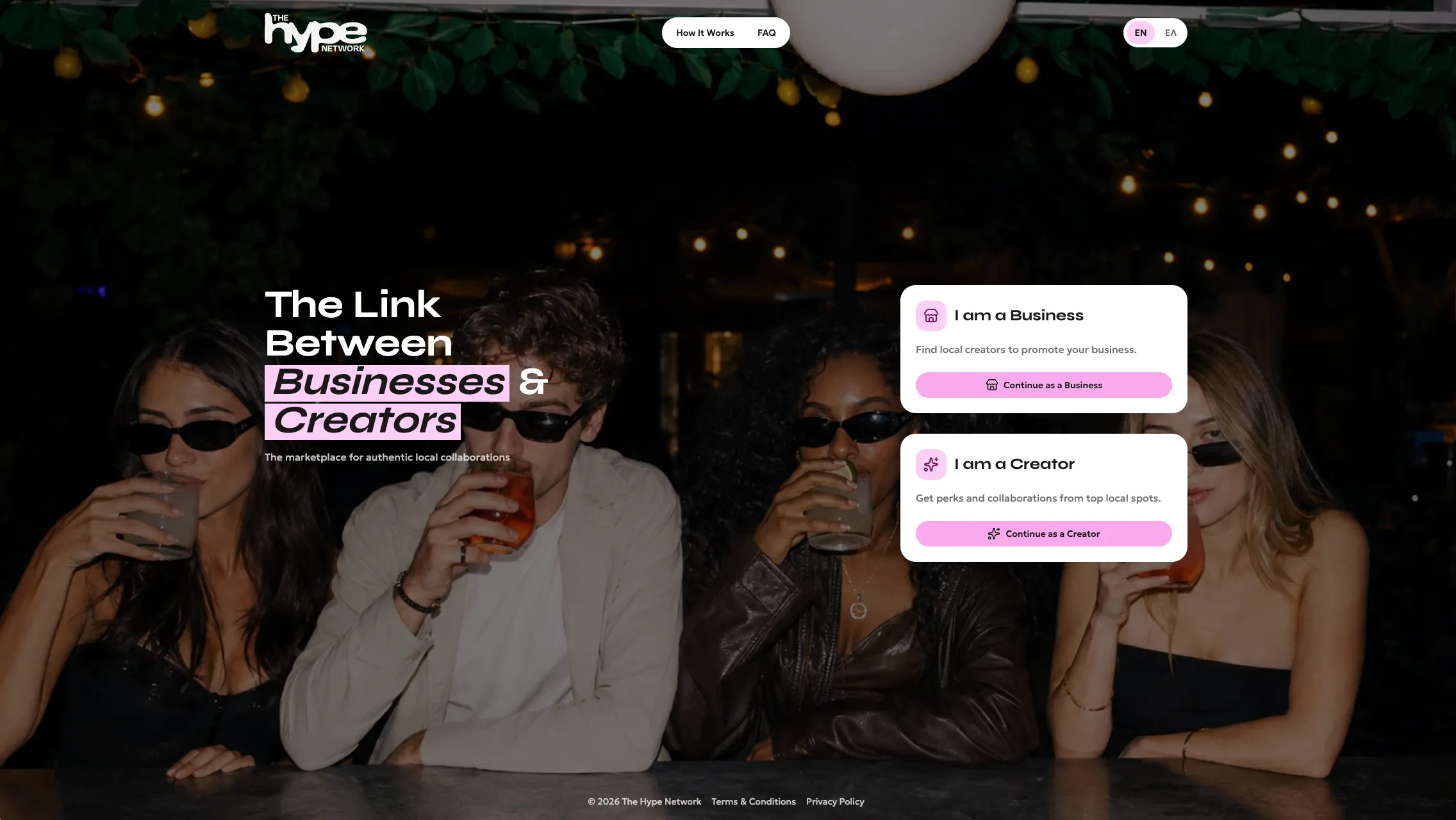
The Hype Network marketplace landing page
24 Weeks
Product roadmap optimized for time to market.
4 surfaces
Marketplace, Backoffice, Website, API integrations
40% Faster
Cutting away the fluff by driving the high level execution roadmap.
The Story
The Hype Network's founders had the market, the brand, and a long feature list. They needed a technology partner they could trust with the product delivery lifecycle, and with the call about what the first release had to carry.
What the first release had to settle:
  • Which features the business actually needed to operate
  • Whether the product could take money at ship or only later
  • Two audiences in one codebase, without forking into two products
  • Infrastructure and product logic that can adapt quickly to change
Testimonial

We came to Programium with a market, a brand, and a ton of ideas. Six hours of mapping turned those ideas into a clear plan for what we actually needed to build. They’re direct, challenge your thinking, and care about getting things right, not just getting them done. That standard shows in the product. We found ourselves ahead of competitors who had already been in the market for over a year. Ten months in, they’re still the team we trust to build with.

Harry Kouklakis
Harry Kouklakis
CEO and Founder, The Hype Network
;
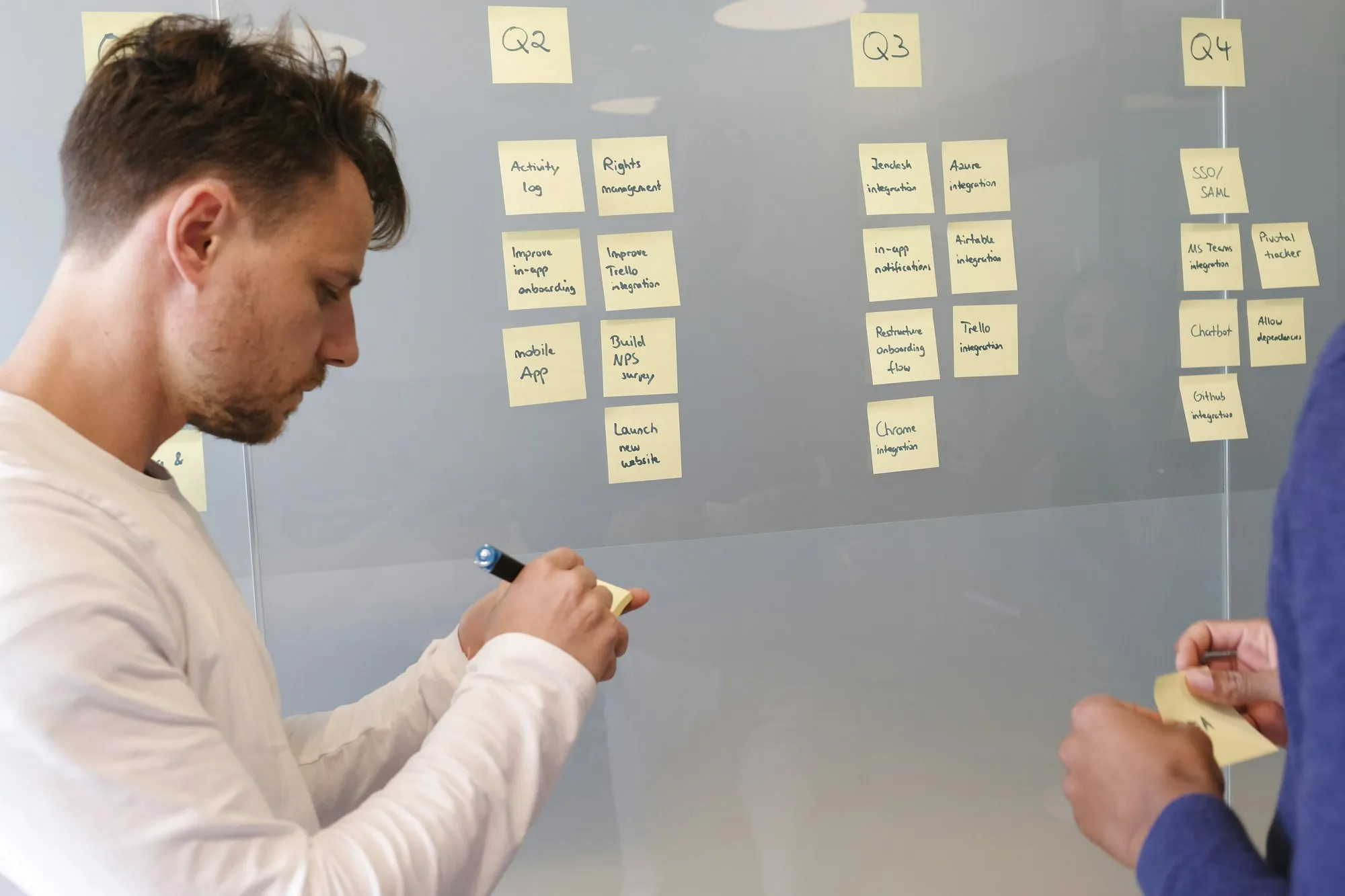
Six hours in the room
Two sessions of three hours with Programium. The preparation ran for days before the first one and continued between the two, which is why six hours in the room was enough.
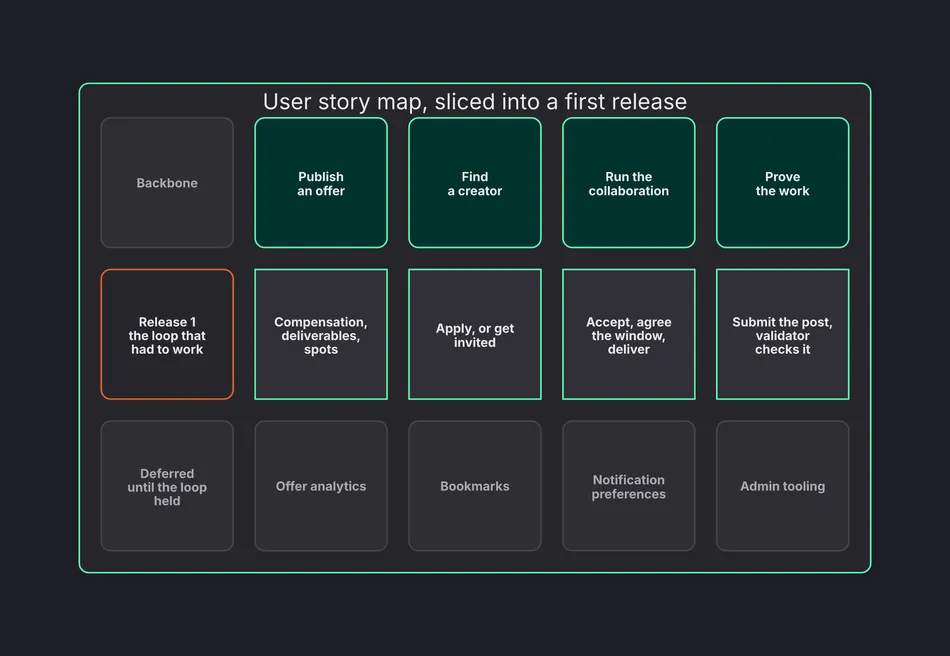
One rule decided every card on the wall
If user data did not validate the need, it did not ship. Bookmarks went up early and nobody disagreed that businesses would want to save creators they liked. It came down when we asked what a business would do with a saved creator before there were offers to invite them to. It waits until the loop it depends on is busy enough to need it.
A user story map for The Hype Network: the backbone of activities across the top, the Release 1 slice holding the collaboration loop, and the deferred work below the line

The exception we kept

Cutting to the minimum usually takes payments with it, because monetization is the easiest thing to promise for later. We kept Payments in the first release. A marketplace that cannot take money is a demo, and a demo cannot tell you whether businesses will pay for access to creators. Three paid tiers shipped with the loop, so the product could be sold the week it existed.
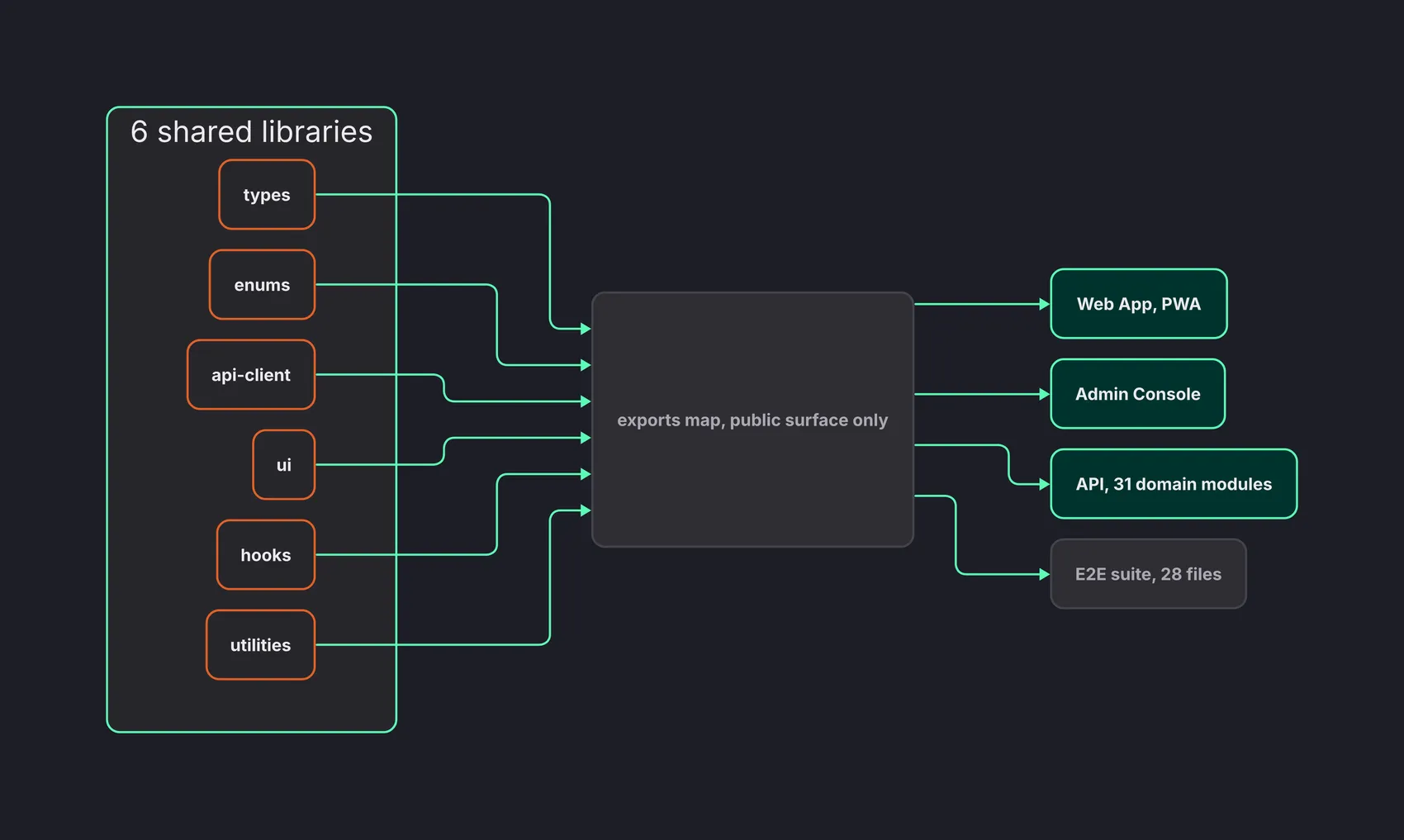
The six shared libraries, each exposing only what its exports map declares, feeding the web app, admin console, API and end-to-end suite
Social Media Provided Identity
Social Media Providers prove the identity of our users. A creator cannot call a business endpoint, because for them the route does not exist. The standards underneath are OAuth 2.0 and OIDC, which matters if you are integrating with it and not at all if you are using it.
2-Sided Marketplace
Social identity providers, the Instagram and TikTok reads that keep follower counts sourced rather than claimed, and Stripe Billing all sit behind that same identity layer. Adding the next one does not mean another login.
Limits that hold outside the UI
The ceilings on live offers and creator invitations sit in backend guards, not in the interface, so there is exactly one place the limit is decided.
We provided:
  • Platform Architecture & Data Modelling
  • Backend Services & Typed APIs
  • Two-Sided Web App, PWA
  • Back-office Portal
  • UX & UI Design, Design System
  • Bilingual Marketing Site
  • Third-Party Integrations
  • Automated Testing & QA
  • Infrastructure as Code & CI/CD
  • Security Review & Observability
Technologies used:
What survived the cut
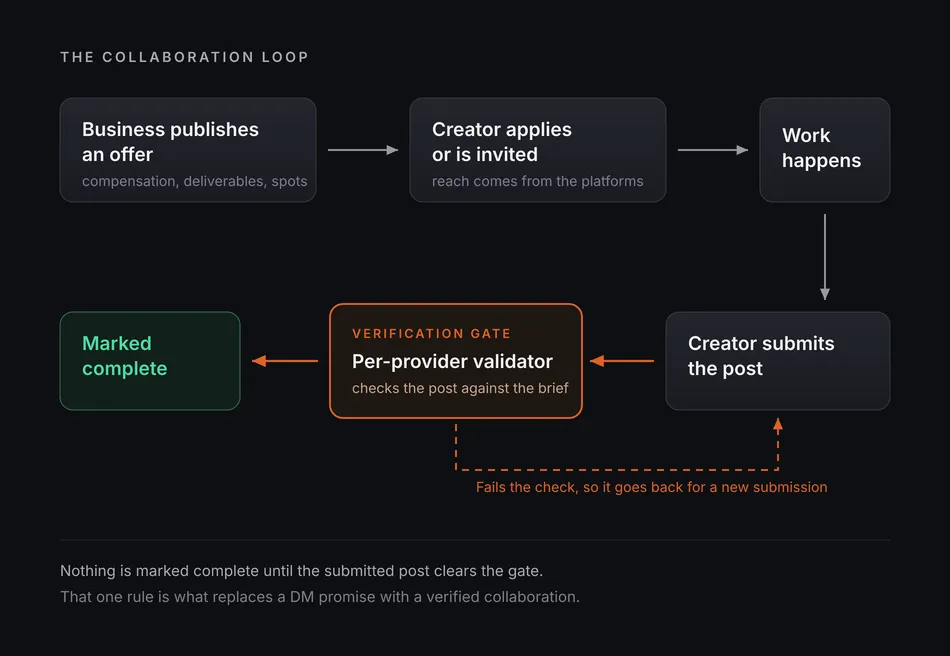
A business publishes an offer, a creator applies or is invited, the collaboration runs, the work is verified.
Four things, and the payments to sell them
Analytics, bookmarks, notification preferences and backoffice tooling all sat behind that loop. The compensation models the founders knew their market wanted, complimentary through to commission and event access, each became a data model that would not need rewriting when the next one arrived.
The collaboration loop: a business publishes an offer, a creator applies or is invited, work happens, the creator submits the post, and a per-provider validator verifies it before it is marked complete
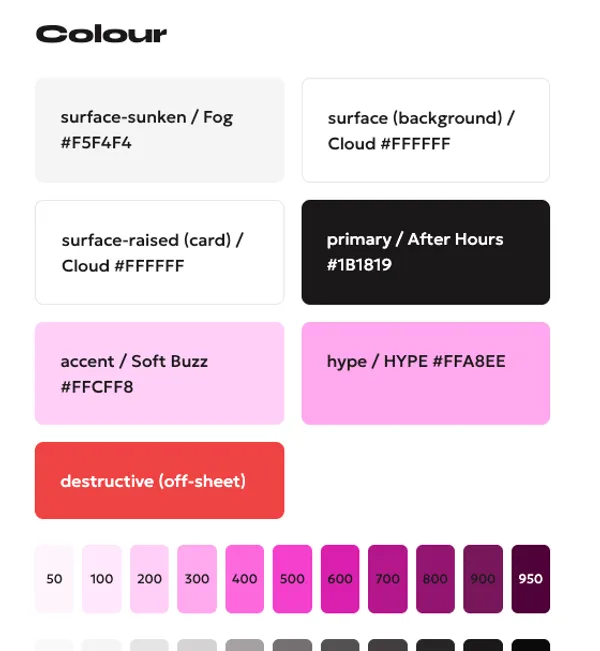
The Hype Network design system colour tokens, each semantic name mapped to an exact hex from the brand palette sheet
One contract, compiled everywhere
An API change used to mean hunting down every caller. One schema library now validates the request on the server and types the response in the browser, so a breaking change fails the build, not production.
The founders had their brand voice already decided, so the design system exists to carry it across all four surfaces. Every colour and radius resolves to one source of truth, including the contrast ratios that fall short of AA and what to use instead.
Adaptability to change
Every environment is managed, down to the identity itself. Nothing was clicked into existence in a console, so an environment that drifts can be rebuilt from source.
Pipelines migrate, seed and deploy. Audit trails record who changed what at the database level, with the acting user carried through the transaction.
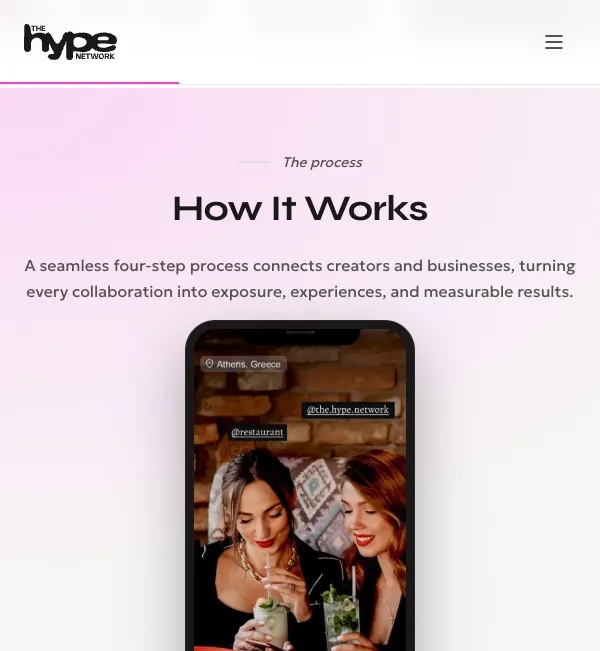
The live Hype Network marketing site at thehypenetwork.io, showing the How It Works section with the collaboration flow on a phone
What we delivered

The Outcome

Four surfaces in 24 weeks

The marketplace, the back-office portal, the marketing site and the API integrations behind all of it, delivered and run by one senior team.

Sellable the week it shipped

Payments were in the first release rather than the second, so the business could charge for access from the start. The end-to-end suite runs against a real PostgreSQL container rather than mocks, cloning a template database so every test starts clean.

Why It Worked

Six hours of mapping decided six months of building. The list that arrived would have spent the runway before the product could earn, and the cut is the reason four surfaces fit in the timeline.

The marketplace mechanics are the product. Every architectural decision served that loop staying trustworthy as it grows. The engagement continued past the first release, and we are still shipping with them.

Let’s Build What Matters

Have something that needs building?

Tell us what you are working on. In a free discovery call we go through your requirements together, and you hear plainly what it would take to build.
Book a discovery call Arrow icon
Programium full logo letters white
Driven by your success, powered by purpose.
[email protected]

Our Office

Greece Leoforos Kifisias 44 15125 Athens